
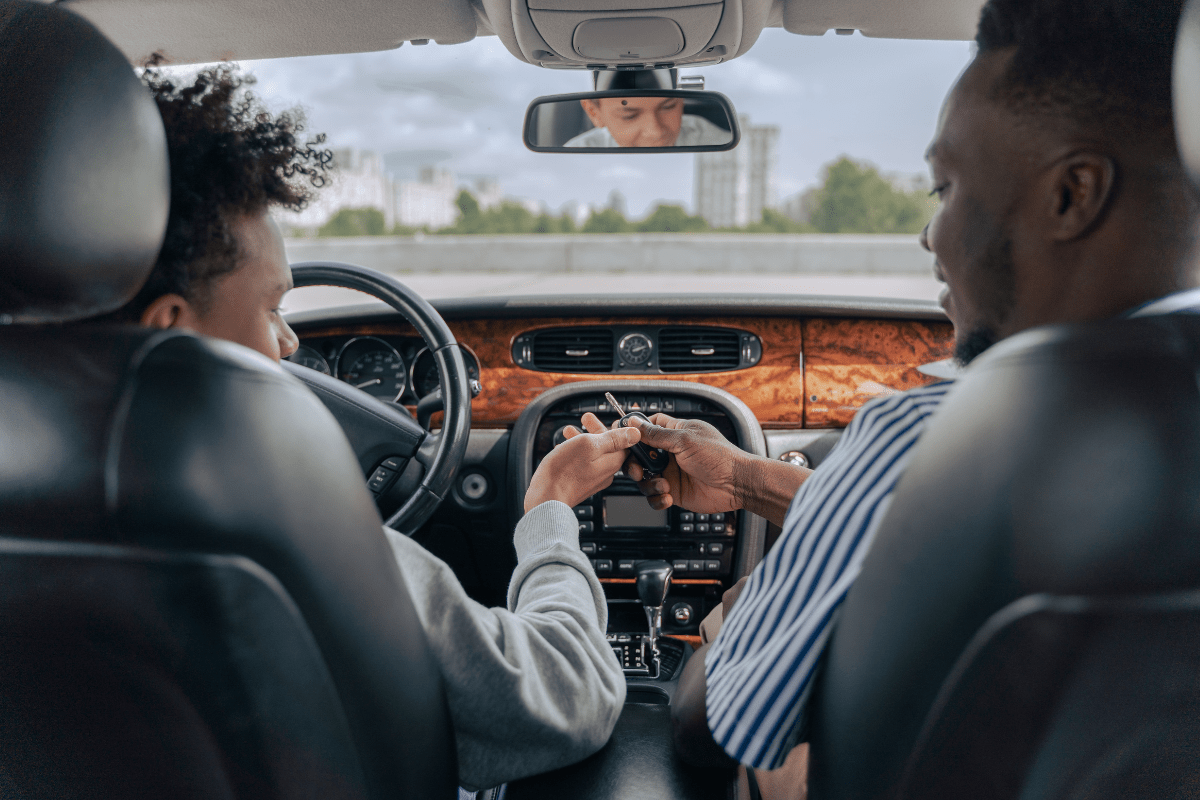
Teaching your teenager to drive might be the most terrifying thing you'll do as a parent, and that's saying something if you've already survived the toddler years. The good news is that millions of parents have successfully navigated this milestone without requiring therapy afterward. Here's how to teach your teen to drive while preserving both your sanity and your relationship.
Start modeling good behavior right now (yes, today)
The most important driving lesson begins years before your teen touches the steering wheel. Your teenager has been your captive audience for thousands of car rides, silently cataloging every rolling stop, aggressive lane change, and creative vocabulary word you've directed at other drivers.
Stow your phone, wear your safety belt no matter how short the ride, obey traffic laws and avoid aggressive driving—that behavior will help shape your teen's judgment. I know it's tempting to quickly check that text at a red light, but your future self will thank you when your teen doesn't inherit that habit.
Start pointing out dangerous behaviors you see on the road. When someone cuts you off, resist the urge to unleash your inner road warrior and instead say something like, "See how that driver didn't check their blind spot? That's exactly why we always turn our head to look." Your teen might roll their eyes now, but they're absorbing these lessons.
Build their navigation skills before they drive
Help your teen better understand their city by pointing out major streets and frequently traveled routes. You can even put them in charge of calling out directions for errands or longer trips. This isn't just about knowing where they're going, it's about developing spatial awareness and understanding traffic patterns.
Make your teen the designated navigator on family trips. Have them:
- Read upcoming exit signs aloud
- Identify major intersections and landmarks
- Use GPS apps for route planning
- Call out street names during drives
Teach the full picture of car ownership
Most parents focus entirely on the driving part and forget about everything else that comes with having a car. Help your teen understand the tasks associated with driving, from pumping gas and cleaning the car, to changing windshield wipers and understanding dashboard warning lights. Highlight the financial responsibilities, including insurance, too.
Show them how to check tire pressure, what those mysterious dashboard lights mean, and how much it actually costs to keep a car running. Nothing motivates careful driving like understanding that insurance rates can double after an accident.
Master the art of passenger seat coaching
Let's be honest: sitting in the passenger seat while your teenager drives feels like the world's worst theme park ride. Your normal parenting superpowers are useless when you can't physically take control, and your teen suddenly becomes a selective listener who can't hear anything you say.
The key is managing your own stress first. Take deep breaths, keep your hands relaxed (death-gripping the door handle helps no one), and remember that your emotional state directly affects their learning.
Use words that actually help
Your choice of words can make the difference between a productive lesson and a screaming match. Instead of "STOP!" try "slow down gradually." Rather than "You're not looking around enough," say "check your mirrors now." And please, resist the urge to gasp dramatically every time they get within three feet of another car.
Decades of driving experience will evaporate as your every bad driving habit is dissected and discussed, complete with page and paragraph notation to prove your lack of roadworthiness. Yes, your teen will absolutely use the driver's manual against you. Embrace it as a teachable moment about consistency.
Adapt your teaching style to your teen
I have three sons, all relatively close in age, and each required a different method of driving instruction. My oldest was a natural and had a severe case of overconfidence that needed taming. My second was hesitant and took his sweet time.
For overconfident teens, set firm boundaries and don't be afraid to use real crash statistics to ground their perspective. For anxious teens, build confidence with lots of practice in safe environments and celebrate every small victory. For easily distracted teens, keep lessons short and remove all distractions, including music.
Set up their first lesson for success
The first time your teen gets behind the wheel sets the tone for everything that follows. Do this wrong, and you'll spend weeks undoing bad habits and rebuilding confidence.
We teach the kids to drive on an essential, stripped car with no rear camera or warning lights on the mirrors. While backup cameras and lane departure warnings are great safety features, learning on a basic vehicle builds fundamental skills that technology can't replace.
Complete vehicle familiarization first
Before you hit the road, start by teaching your teen the basics: demonstrate how to adjust the seat along with the side and rearview mirrors. Make any other accommodations that are necessary, such as tilting the steering wheel.
This isn't optional. Spend at least 10 minutes going through every control before the car moves an inch:
- Proper seat and mirror adjustment
- Location of turn signals and hazard lights
- Windshield wipers and headlight controls
- How to start and turn off vehicle
- Understanding the gear selector
Start in an empty parking lot
One of the best places to teach your teenager to drive is an empty lot. There, your teen can have the space to comfortably get a feel for everything. School parking lots on weekends work perfectly, as do empty shopping center lots early in the morning.
Structure that first session carefully. Start with five minutes of sitting in the driver's seat with the engine off, just getting comfortable with the controls. Then move to practicing acceleration and braking while stationary. Only after they've mastered the feel of the pedals should you attempt any actual movement.
Build skills gradually over time
There is a lot of information to learn, so it's best to focus on only a few things at a time. Resist the urge to cram everything into marathon sessions. Your teen's brain can only process so much new information before it starts shutting down.
Phase 1: Basic vehicle control (weeks 1-2)
Keep it simple during the first few weeks. Focus entirely on smooth acceleration and braking, staying centered in a lane, and basic turns without overcorrecting. Make sure to go at their pace. It may take a few lessons in an empty parking lot before moving on to a quiet street with other cars.
Master these skills before moving on:
- Smooth acceleration and gentle braking
- Staying centered between lane lines
- Basic right and left turns
- Parking between designated spaces
- Understanding proper following distance
Phase 2: Real traffic navigation (weeks 3-6)
For the next several lessons, stick to roads that have slower speed limits (under 35 mph). Emphasize that the posted limit is only a guide for an acceptable maximum speed in excellent conditions.
Start introducing four-way stops, traffic lights, and basic right-of-way situations. This is where many teens struggle because they have to coordinate vehicle control with decision-making about other traffic.
Phase 3: Complex driving situations (weeks 7-12)
Driving on a multi-lane highway for the first time can be scary. Start your teen out by driving at quieter times of the day to practice merging into traffic, staying in the lane and using higher speeds and safe following distances without the added stress of rush-hour traffic.
Gradually expose them to different conditions on familiar routes. Add highway driving, night driving in well-lit areas, and eventually some weather challenges like light rain.
Teach defensive driving, not just rule following
The driving test focuses on following traffic laws, but real-world safety requires much more. Teach your teen to keep a clear "safety space" around the car so there's room to react to any hazards. The farther he or she hangs back from the vehicle in front, the better your teen may be able to see what's ahead.
Master the fundamentals of defensive driving
Teach the three-second rule properly: pick a fixed object like a sign or tree, and when the car ahead passes it, count "one-thousand-one, one-thousand-two, one-thousand-three" before you reach the same point. In bad weather or heavy traffic, increase it to four or five seconds.
Emphasize continuous scanning. Their eyes should move every few seconds between mirrors, gauges, the road ahead, and peripheral vision. Most new drivers develop tunnel vision and miss important information happening around them.
Address the phone problem head-on
The National Highway Safety Traffic Administration shared research that dialing a phone number while driving increases your teen's risk of crashing by six times, and texting while driving increases the risk by 23 times. These aren't just statistics to mention casually, they're life-and-death numbers.
Establish non-negotiable rules about phone use and stick to them:
- Phone completely silent and out of reach
- No hands-free calls during learning phase
- Music selection done before driving begins
- Zero tolerance policy with clear consequences
Consider downloading a parent-teen driving contract to formalize these rules and make expectations crystal clear.
Avoid the most common parent mistakes
Teaching teens to drive brings out some of our worst parenting instincts. Here are the mistakes that sabotage progress and how to avoid them.
Don't skip practice or make it irregular
The phrase "practice makes perfect" exists for a reason. Sporadic lessons lead to skill regression and slower overall progress. Block out specific times each week and treat them as unmovable appointments.
Short, frequent sessions work better than occasional marathon lessons. Thirty minutes twice a week beats two hours once a week, especially in the beginning when everything feels overwhelming.
Never teach when you're stressed or rushed
If you're running late, having a bad day, or dealing with other stresses, postpone the lesson. Your teen will pick up on your emotional state, which increases their anxiety and reduces learning effectiveness.
Focus on judgment, not just rules
Many parents emphasize memorizing traffic laws but fail to develop decision-making skills. Ask "what if" questions during drives: "What would you do if that pedestrian stepped into the street?" or "How would you react if the car ahead stopped suddenly?"
Know when to call in reinforcements
Sometimes parent-taught driving lessons just don't work, and that's okay. Consider professional driving instruction if you and your teen consistently clash during lessons, if your teen seems overly anxious or resistant to feedback, or if you don't feel confident teaching complex skills like highway merging.
Professional instructors provide unbiased, experienced feedback and guidance, which complements parental teaching. Even a few professional lessons can supplement your teaching and provide valuable outside perspective.
Some teens simply learn better from someone who isn't their parent. There's no shame in recognizing this and getting help from qualified instructors who deal with nervous teen drivers every day.
Prepare them for real independence
Don't go from supervised driving directly to complete freedom. Create intermediate steps that build confidence and responsibility gradually.
Start with solo drives to specific, familiar destinations during daylight hours only. Then allow driving with one responsible friend. Gradually expand their geographic area and time restrictions based on demonstrated responsibility and good decision-making.
Be a good example and get involved in their driving habits from the beginning, and stay involved for the duration of their teen years. Continue conversations about close calls, challenging situations they've encountered, and any peer pressure involving cars.
The bigger picture
Teaching your teen to drive is about much more than passing a driving test. You're developing judgment, responsibility, and decision-making skills that will serve them throughout their lives. What we do is much more important than what we say and will become the blueprint for our kids as they move into adulthood.
No matter what it is, no one is an expert on their first try. When your teen messes up, take a deep breath, and encourage them to try again. Every skilled driver started exactly where your teenager is now, making the same mistakes and learning the same lessons.
The process will test your patience and probably result in a few more gray hairs. But it's also an incredible opportunity to watch your teenager develop real-world competence and responsibility. Before you know it, you'll be watching them drive away independently, and if you've done your job right, you'll actually feel good about it.